| Home Prev |  NetWall 200R Series Getting Started Guide NetWall 200R Series Getting Started Guide
|
Next |
|---|
This section describes connecting power. As soon as power is applied, the NetWall 200R Series will boot-up and cOS Core will start.
![[Important]](images/important.png) |
Important: Review the safety information |
|---|---|
|
Before connecting power, please review the electrical safety information found in Chapter 7, Safety Precautions. |
Connecting AC Power
To connect power, follow these steps:Plug the power adapter into a suitable AC power outlet.
There is no On/Off switch. The 200R Series will boot up as soon as power is applied and cOS Core will start. The progress of the process can be seen on a CLI console connected to the local console port.
After a brief period of time, cOS Core will be fully initialized and the NetWall 200R Series is then ready for configuration using a direct console connection or via a network connection to the default management Ethernet interface.
Initial cOS Core configuration is described in Chapter 4, cOS Core Configuration.
|
Important: Consider power surge protection |
|---|---|
|
It is recommended to consider the purchase and use of a separate surge protection unit from a third party for the power connection to the NetWall 200R Series hardware. This is to ensure that the appliance is protected from damage by sudden external electrical power surges through the power cable. Surge protection is particularly important in locations where there is a heightened risk of lightning strikes and/or power grid spikes. Any surge protection unit should be installed exactly according to the manufacturer's instructions since correct installation of such units is vital for them to be effective. |
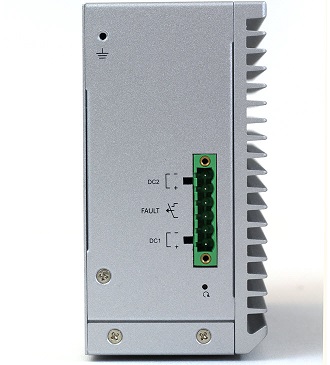
| Connector/Pin | Signal/Function | Voltage Range |
|---|---|---|
| DC2+ | DC Positive | 9-36v |
| DC2- | DC Negative | n/a |
| FAULT Pin1 | Power fault detection | n/a |
| FAULT Pin2 | Power fault detection | n/a |
| DC1+ | DC Positive | 9-36v |
| DC1- | DC Negative | n/a |
Figure 3.5. Power Connectors
![[Note]](images/note.png) |
Note: The FAULT pins |
|---|---|
|
If DC1 or DC2 is not powered, the FAULT pins will be a closed connection that can be used to alert that redundant power is not available to the device |